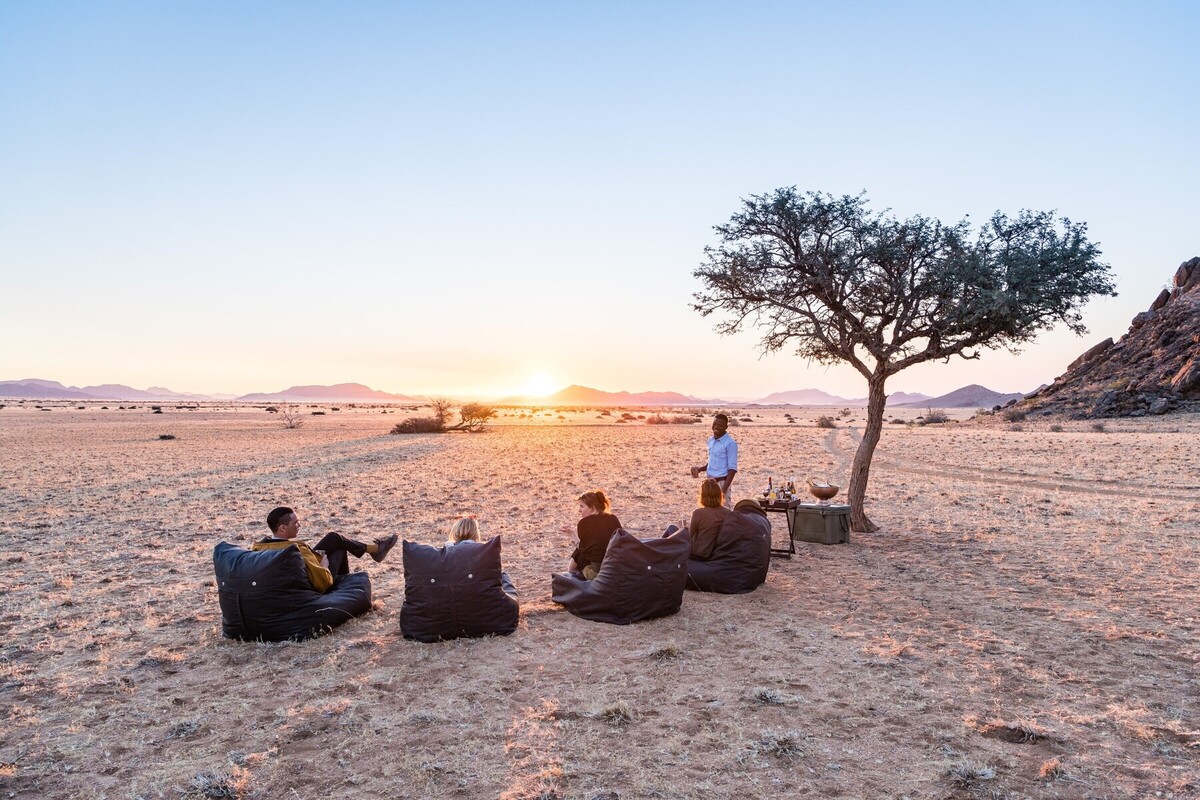
Namibia On Foot Safari
Destination
Namibia
Travel Period
April – September
Duration
12 days | 11 nights
Day 1 – 2: Kalahari Red Dunes Lodge, Kalkrand
Day 2 – 4: Tok Tokkie Trails, NamibRand Nature Reserve
Day 4 – 6: Camp Sossus, Sossusvlei
Day 6 – 8: Strand Hotel Swakopmund, Swakopmund
Day 8 – 9: Ongava Lodge, Ongava Game Reserve
Day 9 – 11: Onguma Trails Camp, Onguma Private Reserve
Day 11 – 12: Okonjima Plains Camp, Okonjima Nature Reserve
The Kalahari Desert covers a huge area of Namibia, Botswana, and South Africa. The classic scenery of long red sand dunes, which can turn green during the summer months, includes fascinating plant life and, although it is often overlooked for the epic sand dunes of the Namib desert and for the wildlife in Etosha, it still offers a raw and authentic experience with plenty of its own desert-adapted flora and fauna.
The Kalahari is also one of the ancestral homes of the Khoisan bushman, who have lived here for more than 20,000 years. Traditionally nomadic hunter-gatherers living in small cluster groups across Southern Africa, they were forced into the Kalahari away from other tribes, but now many live a more sedentary lifestyle and rely less on their traditional hunter-gatherer origins. However, to spend time with these fascinating people is truly a privilege.
Past the towns of Mariental and Reheboth, past the iconic Quiver tree forest you can travel to the south of the country to the Kgalagadi Transfrontier Park, one of the first ‘peace parks.’ At an impressive 38,000 km2, the area offers good wildlife viewing, where you can find cheetah and leopard as well as the famous black maned lions.
Though not a Big 5 park, the Kgalagadi Transfrontier Park has plenty to offer including fantastic bird of prey sightings. The park is actually located in both South Africa and Botswana but there is a park entrance on the South African and Namibian border. To access the park, you do not even need to get a visa for South Africa, provided you also exit through the same Namibian gate again.
Read more...
Kalahari Red Dunes Lodge offers ample space and privacy. The main lodge with reception, lobby area, restaurant and bar and swimming pool with sundeck is set in a dry lake. A 120 metre boardwalk connects the main lodge to the guest houses, which are situated around the dry lake where game can be seen. Each guesthouse has a canvas-walled area, a stone-walled area with a thatched roof and a private terrace with comfortable sofas.
Suite
Spanning 70 m², each of the Suites at Kalahari Red Dunes Lodge features a unique design combining canvas, natural stone, large windows, and thatch for a luxurious African feel. Each suite includes a spacious bedroom, a living room, a large bathroom, a private terrace with pool loungers and deck chairs, and an outdoor shower. Amenities include air conditioning, a fully stocked minibar, an espresso machine, a tea station, wifi, a mosquito net, a safe, a hairdryer, and high-quality locally made bath products.
Read more...
On hikes and game drives guests can experience the breathtaking beauty of the Kalahari with its red dunes up to 30m high and abundant wildlife. Activities include Kalahari nature/game drives, guided and unguided hikes, mountain biking and the Trans Kalahari Walk – a two-day trek through the Kalahari dunes with one night at the Kalahari Red Dunes Lodge and one night in a luxury tented camp.
Read more...
At more than 200,000 hectares in size, the NamibRand Nature Reserve is one of the largest private reserves in southern Africa. It was established in the 1980s when Albi Bruckner integrated several livestock farms into a protected wilderness area and today it’s a model of conservation success. There are strict rules about the number of lodges built in the area (and even stricter rules about the number of rooms each one may have), making it a totally private and entirely exclusive adventure.
Photographs may show the craggy, mauve mountains of the NamibRand, the infamous red dunes and the enormous swathes of desert, but nothing prepares for you the moment you see it for yourself. The space is humbling, the sense of peace is spiritual and it’s one of the most striking, stirring places out there. The fairy circles that dot the ground are particularly intriguing. Over the years, the theories behind them have been hotly debated (they are a result of poisonous fungi, termites, or even meteor showers), however no one really knows for certain why they are here. Just another reason to visit this extraordinary place.
You might not find the Big Five wandering around the harsh desert of the NamibRand, but the dunes are home to a variety of wildlife that has adapted in many fascinating ways in order to survive. Take, for example, the gemsbok with their white bellies that reflect the heat of the sand and their sophisticated vascular system that cools the blood around the brain. Or the bat-eared fox – those giant ears aren’t just for comic value but help to amplify the sound of their predators approaching.
What you’ll undoubtedly see most of are antelope. From gemsbok to springbok, kudu to steenbok, they can be found in most corners of the reserve, silhouetted against the red sand. You may also spot Burchell’s zebra amid the dunes as well as the more unusual black-backed jackals, aardwolves and African wild cats, which can be surprisingly easy to find compared to other reserves on the continent. Leopard and cheetah are rare but there are small numbers of both.
Read more...
The exclusive guided desert walking trail at NamibRand Nature Reserve offers a leisurely and personal 2-night, 3-day experience, fully catered and expertly guided. Tok Tokkie Trails takes you deep into the heart of the desert’s stunning beauty, where walking allows you to uncover secrets of the Namib that are inaccessible by vehicle.
You’ll traverse various desert landscapes, from mountainous terrain to sandy dunes, accompanied by a nature guide who will introduce you to the diverse life forms that inhabit this harsh environment. The trail is designed for small groups of 2-8 guests, ensuring a private and immersive experience where you can savor the vast calmness of the desert at a relaxed pace. Your comfort is ensured by a service team that transports your luggage and prepares meals, allowing you to fully enjoy the beauty of your surroundings.
Accommodations during the trail include nights spent under the Namibian sky in a cozy stretcher bed. Facilities include a hot bucket shower and an open-air toilet with stunning views. Meals, including breakfast, lunch, sundowners, and romantic three-course dinners, are enjoyed in the dunes, adding a touch of luxury to your desert adventure. The experience is designed to be both comfortable and enriching, with only light hiking required and all necessary equipment provided, allowing you to immerse yourself fully in the tranquil and awe-inspiring desert landscape.
Camping
Experience nights under the Namibian sky in your private stretch of dunes, sleeping in a cozy stretcher bed complete with a mattress, duvet, and cushion. Enjoy a hot bucket shower and an open-air toilet with a splendid view of the surrounding landscape.
Read more...
Exclusive guided desert walking trail at NamibRand Nature Reserve.
Read more...
Sossusvlei is a photographer’s dream. In fact it is so unique and beautiful that it is hard to take a bad picture. Only a five hour drive from Namibia’s capital, Windhoek, it is one of the most sought after and unique destinations in the country. The stark yet ethereal beauty of Namibia is on full display here with the skeletal remains of old camel thorns strewn amongst salt pans, surrounded by some of the most spectacular sand dunes in the world. This endless expanse of wilderness is home to desert adapted species such as the Gemsbok (Oryx).
One of the most mysterious natural phenomena of the surrounding Namib Desert are the weird and wonderful fairy circles that give the desertscape an eerie lunar appearance. These are perfectly circular patches of grass that are inexplicably spaced evenly apart and never overlap. The area is extremely dry but every so often when it does rain it can transform the pans into a paradise for thousands of waterbirds, with the appearance of a sea of stunning wildflowers.
Read more...
Camp Sossus is located in the Namib Tsaris Conservancy, nestled between the Nubib and Zaris Mountains, just a 30-minute drive from the gateway to Sossusvlei and the Great Namib Sand Sea, which was recently declared a World Heritage Site. Built within a naturally formed amphitheater of a south-facing granite outcrop, Camp Sossus is within striking distance of Sossusvlei and is ideally positioned to provide shade from the harsh desert sun.
The severe desert climate was a primary consideration in the camp’s design, and tents are protected from the stormy east winds by natural stone walls and shaded by roofs built from almost 500 recycled oil drums. It is also equipped with furniture built in part from recycled metals, Oregon pine floorboards, and wooden pallets. As a result of this design, the camp is virtually invisible from any distance and it carries one of the lowest environmental footprints of any camp in Namibia.
Luxury Tent
Six shaded luxury tents are furnished with twin beds, and have semi open-air en-suite bathrooms with flush toilets and bucket showers (with hot water, on request). The tents are run on solar power and feature a shaded day-bed/sala and an open star bed on deck above the tent.
Read more...
Guided Activity In Sossusvlei
This morning you will rise early for a magical excursion into the Namib Naukluft National Park, entering the Park gates at sunrise to capture the dunes whilst the light is soft and shadows accentuate their towering shapes and curves. This area boasts some of the highest free-standing sand dunes in the world and climbing Big Daddy dune is a must.
Your guide will give you an insight on the formation of the Namib Desert and its myriad of fascinating creatures and plants that have adapted to survive these harsh environs.
Once you have explored the areas around Sossusvlei and Deadvlei to your hearts content you can enjoy a picnic in the shade of a camel thorn tree. Return to your lodge in the early afternoon for a late lunch. The rest of the afternoon is at your leisure (from experience, this is usually welcomed after an exhilarating morning in the dunes) or can be spent on an activity at Camp Sossus, such as a mountain bike tour or sundowner drive.
Read more...
Swakopmund resembles a small, German coastal resort nestled between the desert and the sea. It boasts a charming combination of German colonial architecture blended with modern hotels, shops, restaurants, museums, craft centres, galleries and cafés. Swakopmund had its beginnings as a landing station in 1892 when the German Imperial Navy erected beacons on the site. Settlers followed and made attempts to create a harbour town by constructing a concrete Mole and then an iron jetty – which attempts were ultimately unsuccessful.
The advent of World War one halted developments, and the town sank into decline until half a century later when infrastructure improved and an asphalt road opened between Windhoek and Swakopmund. This made reaching the previously isolated town quicker and easier and it prospered once again to become Namibia’s premier resort town. Although the sea is normally cold for swimming there are pleasant beaches and the cooler climate is refreshing after time spent in the desert.
Swakopmund is just a few hours drive from Namibia’s capital and provides easy access to the Spitzkoppe, another very popular unique destination. A short drive via a scenic coastal road reaches the fishing town of Walvisbay. This road is an excellent place to marvel at the endless desert dunes as they meet the Atlantic Ocean.
Read more...
Strand Hotel Swakopmund is the perfect venue for travelers wanting to explore Swakopmund. This Namibian icon has become a popular destination resort for international, Namibian, and South African guests.
With its extensive, unique, and creatively entertaining restaurants, bars, deli, lobby-lounge, sea-facing terraces, beach kiosk, and state of the art conference and banqueting center, all set on the Mole, a historic and iconic site surrounded by ocean on three sides, the Strand Hotel Swakopmund is a social epicenter and destination in itself for both visitors to and residents of Swakopmund.
Standard Room
All Standard Rooms are designed to accommodate up to two adults and a child in a cot, and feature floor-to-ceiling panoramic and sliding windows with beautiful views of the gardens, en-suite bathroom with shower, single vanity and separate toilet, writing desk, and easy lounging armchair with reading light. Available as an extra-length soft-top king bed or twin bed configuration.
Read more...
Day 7 – Pelican Point Kayaking Tour
The tour starts at the Waterfront office in Walvis Bay. Guests are taken in 4×4 vehicle on a scenic drive along the Walvis Bay Lagoon and the salt mines to Pelican Point, stopping along the way to take pictures of countless flamingoes, pelicans, large flocks of cormorants, and a great variety of other birds and wildlife.
After one hour, guests reach Pelican Point, where they are greeted by thousands of seals. Within a few minutes, the very stable double kayaks are ready for paddling.
You don’t need to be fit or experienced to enjoy a morning of kayaking. The tour stays on the protected side of the peninsula.
Guests spend around one hour on the water, depending on general weather conditions. Dry bags are available if you wish to take your cell phone or camera along, at your own risk.
After kayaking, recharge during brunch with some fresh rolls, coffee, and tea, before heading back to Walvis Bay, arriving by 12h30.
Please note: All the necessary safety equipment can be found on board every vessel.
All kayaking equipment is provided except for water shoes, and it is recommended that guests bring along waterproof shoes or flip flops for wading to the kayak. Guests are recommended to bring along warm jackets, and a fresh set of dry clothes as sometimes sleeves get wet from the kayaking. Warm jackets, waterproof trousers, and dry bags for cameras will also be provided.
Day 7 – Fat Bike Tour Adventure Desert Tour (3.5hr)
Embark on an exhilarating fat bike tour adventure through the stunning desert landscapes surrounding Swakopmund, Namibia. This 3.5-hour guided tour offers a unique way to explore the breathtaking scenery, where the vast Namib Desert meets the Atlantic Ocean.
What to Expect: Pedal through picturesque dunes and enjoy panoramic views of the desert. The specially designed fat bikes allow you to navigate the sandy terrain with ease.
Knowledgeable guides will lead the way, sharing insights about the local flora and fauna, as well as the history and culture of the region.
Keep your eyes peeled for unique desert wildlife, including oryx and various bird species, as you ride through this remarkable ecosystem. Capture unforgettable moments against the backdrop of stunning landscapes, perfect for your travel memories.
Who Can Join: This tour is suitable for all skill levels, from beginners to experienced cyclists. Whether you’re looking for an adrenaline rush or a leisurely ride, this adventure promises an unforgettable experience.
Read more...
In 1991, a group of Namibian, English, American, and South African nature lovers joined forces to purchase 34,000 hectares — about 84,000 acres — of land on the southern boundary of Etosha National Park. Most of the territory was unproductive farmland, a testament to the harsh conditions endured by cattle ranchers in one of the world’s most rain-scarce regions. The dream was to rehabilitate that arid landscape and transform it into a sanctuary for endangered wildlife, beginning with one of the most threatened species of them all: the white rhinoceros.
The transformation of unproductive farmland into the Ongava Game Reserve, a sanctuary for the threatened black and white rhino, as well as other species, is one of Africa’s great conservation success stories.
Ongava means “rhino” in the Herero language, but more than that, it means a place where these magnificent creatures can thrive in their natural habitat, alongside lion, leopard, elephant, cheetah, giraffe, gemsbok, springbok, red hartebeest, eland, wildebeest, zebra, the rare black faced impala, and hundreds of other species.
With four luxury lodges catering to a limited number of guests, Ongava Game Reserve has become a model of safe and responsible ecotourism too, while the Ongava Research Centre serves as a hub for groundbreaking study by scientists and researchers from across the globe.
Ongava also provides easy access to the prime game viewing areas of central Etosha, Namibia’s flagship national park.
Day 8 – Etosha National Park
Etosha National Park, translated as the ‘Place of Mirages’, Land of Dry Water’ or the ‘Great White Place’, covers 22,270 km², of which over 5,000 km² is made up of saline depressions or ‘pans’. The largest of these pans, the Etosha Pan, can be classified as a saline desert in its own right. The Etosha Pan lies in the Owambo Basin, on the north-western edge of the Namibian Kalahari Desert. Until three million years ago it formed part of a huge, shallow lake that was reduced to a complex of salt pans when the major river that fed it, the Kunene, changed course and began to flow to the Atlantic instead.
If the lake existed today, it would be the third largest in the world. Etosha Pan is the largest of the pans at 4,760 km² in extent.
In the late dry season animals congregate in the hundreds around the many water sources, queuing to quench their thirst. When the rains arrive the area is transformed, bringing a plethora of birdlife that comes to take advantage of ideal feeding conditions. Thousands of flamingos and other water birds descend to the flooded salt pans to take advantage of this time of plenty.
Read more...
The well-established Ongava Lodge is situated in the privately owned Ongava Game Reserve along the southern boundary of Etosha National Park. Positioned close to the top of a hill in the foothills of the Ondundozonanandana range, the vantage point is beautiful and overlooks a well-frequented waterhole and the plains beyond.
Ongava Lodge offers luxury accommodation in 14 rock-and-thatch en-suite chalets. There are impressive views over the camp’s waterhole from the main lounge and dining areas, and there is also an inviting pool to cool off in the heat of the day. Meals are either served in the main dining area under thatch or on the dining deck under the stars.
Standard Chalet
Step into comfort and nature’s embrace in the inviting chalets. Each of the 13 chalets offers a serene haven where you can unwind amidst the wilderness. The room has two twin beds that can be converted into a double bed on request. Each suite offers personalized comfort with a cozy ambiance, air-conditioning, and mosquito nets to ensure restful nights. Guests can enjoy tea or coffee in their rooms, with modern amenities like hairdryers and 220V power outlets providing added convenience. The veranda provides a perfect spot to relax with a cup of coffee or a drink while taking in the stunning sights and sounds.
Read more...
Activities include game drives into Etosha, spending time in the camp hide, and nature drives and walks on the reserve. Ongava has resident white and black rhino, giving guests staying at Ongava the opportunity to see both species.
Read more...
Onguma Private Reserve comprises 34,000 hectares of private wilderness on the eastern border of Etosha National Park. The nature reserve boasts over thirty different animal species consisting of plains game including kudu, giraffe, eland, oryx, hartebeest, zebra, impala and many more roam freely as well as predators such as lion, cheetah, leopard, being common residents of the area. The latest addition to the already abundant wildlife at Onguma Nature Reserve is a family of black rhinos.
During the Namibian summer months Onguma becomes a bird-watcher’s paradise with thousands of species migrating to the wetlands created by the seasonal rains and ephemeral river systems.
Etosha National Park is a national park in the north west of Namibia. Proclaimed a park in 1907, it is home to four of the Big Five and offers amazing game sightings all year round.
Read more...
Onguma Trails Camp offers an exclusive, eco-friendly glamping experience with a two-night walking trail, extendable to three nights. Accommodating just eight guests in four en-suite Bell Tents, the camp blends adventure with comfort, featuring extra-length beds, private outdoor bathrooms, and wood-fired hot tubs. Daily guided walking safaris immerse guests in the Namibian bush, with opportunities to track wildlife, learn bush skills, and enjoy scenic meals. Designed with sustainability in mind, the camp operates on solar power and follows eco-conscious practices, ensuring a low-impact yet unforgettable experience.
Bell Tent
The camp features four Bell Tents, accommodating up to eight guests for an intimate and eco-friendly stay. Each tent offers a king-size bed or twin beds, and an en-suite bathroom with a compostable eco-toilet, a private wood-fired hot tub, and a bucket shower with hot water, ensuring comfort while maintaining a low environmental impact.
Read more...
Guests at Onguma can explore the pristine wilderness on guided walking trails, offering the chance to encounter four of the Big Five on foot. Led by experienced guides with rifles, these safari walks provide an immersive way to connect with nature and uncover hidden details of the bush. Along the way, guests can learn essential bush skills and enjoy a scenic sundowner to end the adventure.
Read more...
West of the Waterberg Plateau Park, vast plains are occasionally broken by remnants of ancient sandstone outcrops, which once covered large areas of northern Namibia. Nestled among the Omboroko Mountains, in a Malaria-free area, lies Okonjima – a Herero name meaning “Place of the baboons.”
The Okonjima Nature Reserve, a huge protected area set amongst the rugged commercial farmlands of central Namibia, comprises a diversified ecosystem representative of both the larger and small mammals of Namibia, as well as most of the country’s endemic birds. The Okonjima Nature Reserve is home to, and runs extensive research projects on, rare and endangered species big and small.
The Okonjima Nature Reserve sprawls over 200 square kilometres of undulating plains, mountainous outcrops, and riverine thickets, and it is here that leopard (Panthera pardus), the most adaptable of all the wild cats, thrive.
These intelligent, solitary predators occur in high density in the expanse of Okonjima Nature Reserve’s multi-faceted topography. The Reserve’s predator research programme has spanned three decades, and its findings have provided great insight to leopard behavioral patterns as well as offered an upbeat prognosis for a sustainable future for the species in today’s Africa.
Okonjima is a family-run business. Wayne, Donna and Rosalea Hanssen, who co-own and live on the property, bought Okonjima from their parents, Val and Rose, in 1993, and turned the then cattle farm into a conservation project. Okonjima is so much more than simply an African safari lodge. It is also home to The AfriCat Foundation, which was established when Chinga the Cheetah was bought by the Hanssen’s at a cattle auction and given a home on Okonjima.
The AfriCat Foundation
The AfriCat Foundation seeks to do what it can to conserve large carnivores in Namibia. Founded in 1991, AfriCat is perfectly situated to conduct ecological research focusing on a variety of rare and endangered species. As Okonjima is an enclosed nature reserve, one component of AfriCat’s research focuses on understanding the ecology of leopard and brown hyaenas living within Okonjima, with the ultimate aim of producing informed, sustainable metapopulation management guidelines for these species.
Okonjima was a cattle farm since the early 1920s that was bought by Brahman breeders Val (VJ) and Rose Hanssen in 1970. By the time Namibia gained its independence in early 1990, they needed to address increasing livestock losses and growing interest in Namibia as a tourist destination. Three years later their herds of Brahman and Jersey cattle were sold and Okonjima’s attention turned to recovering the grass plains and transforming it into a nature reserve, with a primary focus on carnivore conservation through The AfriCat Foundation.
Read more...
The Plains Camp is 700m from the airstrip within the secluded wilderness area of Okonjima Nature Reserve and has majestic sunset views. Its design honours the Hanssen’s family cattle-farming history with its three-tier accommodation facilities.
The Plains Camp Barn is an entertainment area and gathering place that includes a dining and lounge area, Wi-Fi facilities and cellphone reception, a bar, a swimming pool and curio shop, all of which overlook a waterhole and the Okonjima plains.
Plains View Rooms
The 10 Plains View Rooms are upmarket, exclusive, and spacious, with a view across the Okonjima plains. Each room has a large verandah and a wheel-chair friendly ramp. The rooms have two double beds, a desk, and comfortable reading chair, a large verandah, a minibar fridge, a coffee & tea station, two ceiling fans, and an ensuite with twin basins and a large twin shower. The exclusive Plains View Rooms are more spacious than the other rooms and are set further apart, providing more privacy.
Read more...
The Okonjima Nature Reserve is a huge protected area set amongst the rugged commercial farmlands of central Namibia. It has a diversified ecosystem representative of both the large and small mammals of Namibia, as well as most of the country’s endemic birds.
A two-day Okonjima stay offers the best chance to view wild leopard in Namibia, as well as those collared for research purposes, in their natural habitats. Research programme leopard are actively tracked, and their collars are an invaluable resource for locating them. This enables them to return to the Reserve any cats that migrate to surrounding farmland where they would be perceived as a threat to livestock.
Game drives and guided bush walks offer visitors an intimate, up-close perspective of Namibia’s wildlife and, especially, its most protected species.
Day 11 – Okonjima Leopard Tracking Activity
The Okonjima Leopard Tracking Activity offers an exhilarating and immersive experience for wildlife enthusiasts and nature lovers visiting the Okonjima Nature Reserve in Namibia. This unique activity allows participants to track leopards in their natural habitat, providing an up-close look at these magnificent creatures while contributing to important conservation efforts.
During the leopard tracking experience, guests are guided by knowledgeable trackers who share insights into the behavior and ecology of leopards. The thrill of tracking these elusive big cats adds an element of adventure, as guests learn to identify signs of leopard activity, such as paw prints and markings.
Read more...
Capture user preferences before routing them to our travel designers.